How to Evaluate a Custom Notebook Manufacturer: A 10-Point Checklist
How to Evaluate a Custom Notebook Manufacturer: A 10-Point Checklist
Ten checks before you choose a custom notebook manufacturer: formats, paper specs, samples, artwork, color, compliance records, payment and export terms.
How to Evaluate a Custom Notebook Manufacturer: A 10-Point Checklist
To evaluate a custom notebook manufacturer, review ten areas before you order: product experience, paper specifications, cover materials, sample approval, artwork requirements, color management, compliance records, communication, payment terms and export responsibilities. Ask each supplier to answer in writing, using the same specification, so you can compare them fairly. The checklist below turns those areas into questions you can send with your first inquiry.
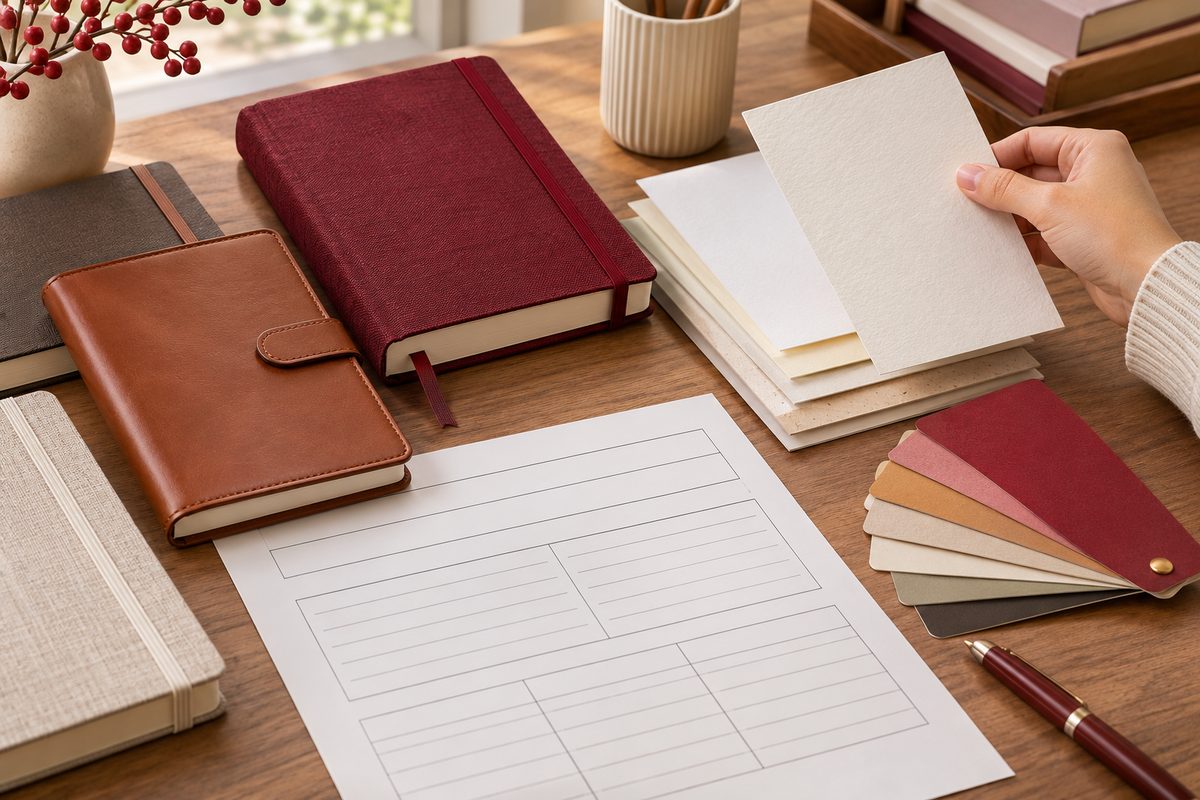
Start with one specification sheet. Send every supplier the same details: finished size, page count, paper type and weight, binding method, cover material, finishes and packaging. Ask them to flag any substitutions they propose. Quotes built on different specs can't be compared.
AI-generated illustration.
Before requesting a quote: product fit and materials
1. They already make your format. Ask for photos or samples of notebooks close to yours: the same cover construction (hardcover or softcover), binding method (sewn, perfect-bound, spiral or ring binder), size and page count. Also ask which production steps are handled in-house and how quality is managed when outside specialists are involved.
2. Paper choices are named, with weights. A good custom notebook manufacturer tells you the paper grade and basis weight (gsm) and explains the trade-offs, such as show-through, pen performance and page thickness. "Premium paper" with no spec is a warning sign.
3. Covers and finishes are described honestly. Foil stamping, debossing and full-color printing should come with clear limits. Watch the wording on cover materials: PU is a coated synthetic and should never be sold to you as genuine leather.
How a custom notebook manufacturer handles samples and artwork
Two common sourcing mistakes are submitting artwork that isn't print-ready and approving production without reviewing a physical sample. Points 4–6 address both.
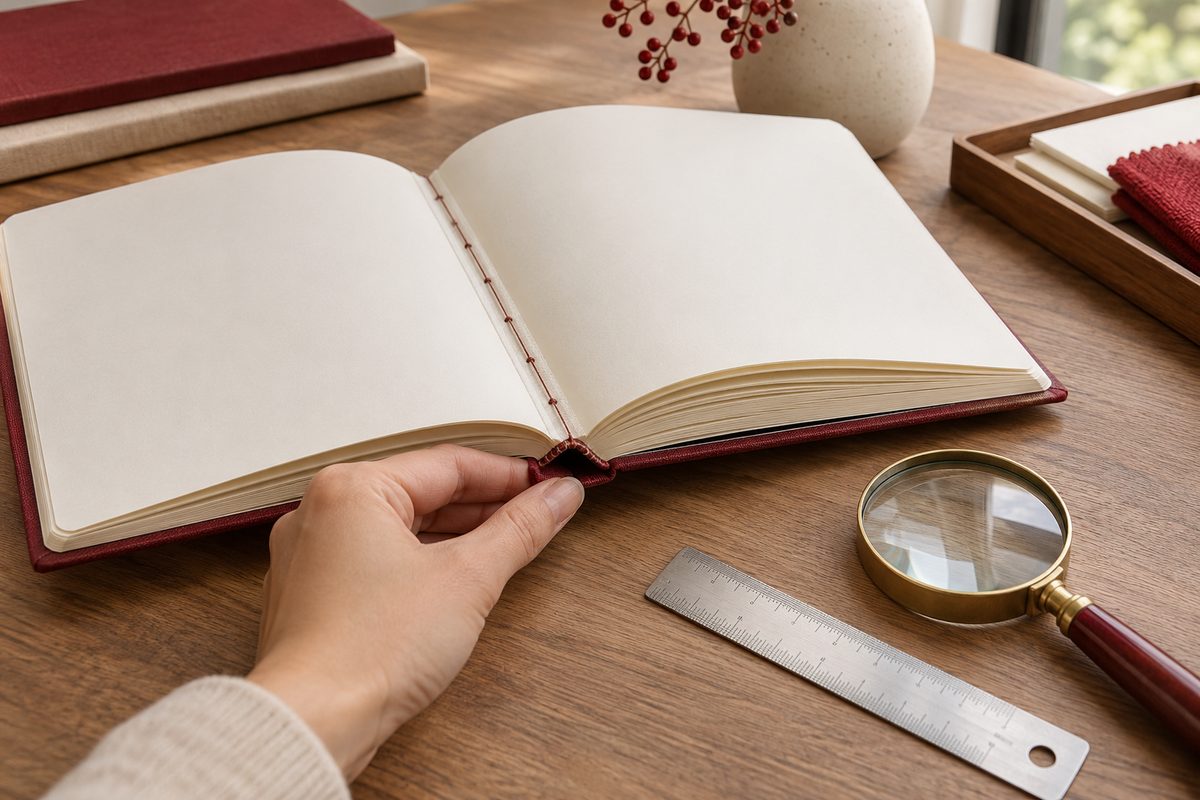
4. The sample is clearly defined. Ask whether you'll receive a pre-production sample made with the specified paper, cover material, binding and finishes. Confirm which details it represents, whether any materials are substitutes, and how revisions and your written approval are recorded before mass production. Digital proofs catch layout errors; a physical sample shows paper feel, construction and print appearance.
AI-generated illustration.
5. Artwork requirements are documented. Ask which file formats the supplier accepts, how vector logos and raster images should be prepared, and which bleed and color settings apply. Photographic images need enough resolution at final print size. Confirm who reviews the files and how proof corrections are approved. PUNDY's requirements are listed in our Print-Ready File Guidelines.
6. Color is managed with references. If brand color matters, supply Pantone or CMYK references and ask how the factory matches them on your chosen paper. Uncoated and cream papers shift color.
Compliance, communication and terms
7. Certifications and audits can be verified. Ask for certificates, audit documentation or membership records, and check them yourself. FSC chain of custody certification verifies that forest materials are tracked through each step of the supply chain, and its status can be checked in FSC's public records (FSC). A product carries an FSC claim only when certified materials are ordered for it. SMETA is an on-site social audit, separate from certification; a 2-pillar audit covers labour standards and health and safety (Sedex).
8. Answers are specific and in writing. Note how long the first reply takes, whether it addresses your actual requirements and whether it lists the details still open. Vague answers at the quote stage are worth resolving before you pay a deposit.
9. Payment and approvals are staged clearly. You should know when the deposit is due, when the balance is due, and which approval unlocks each stage. Also confirm who owns the final artwork and any custom tooling.
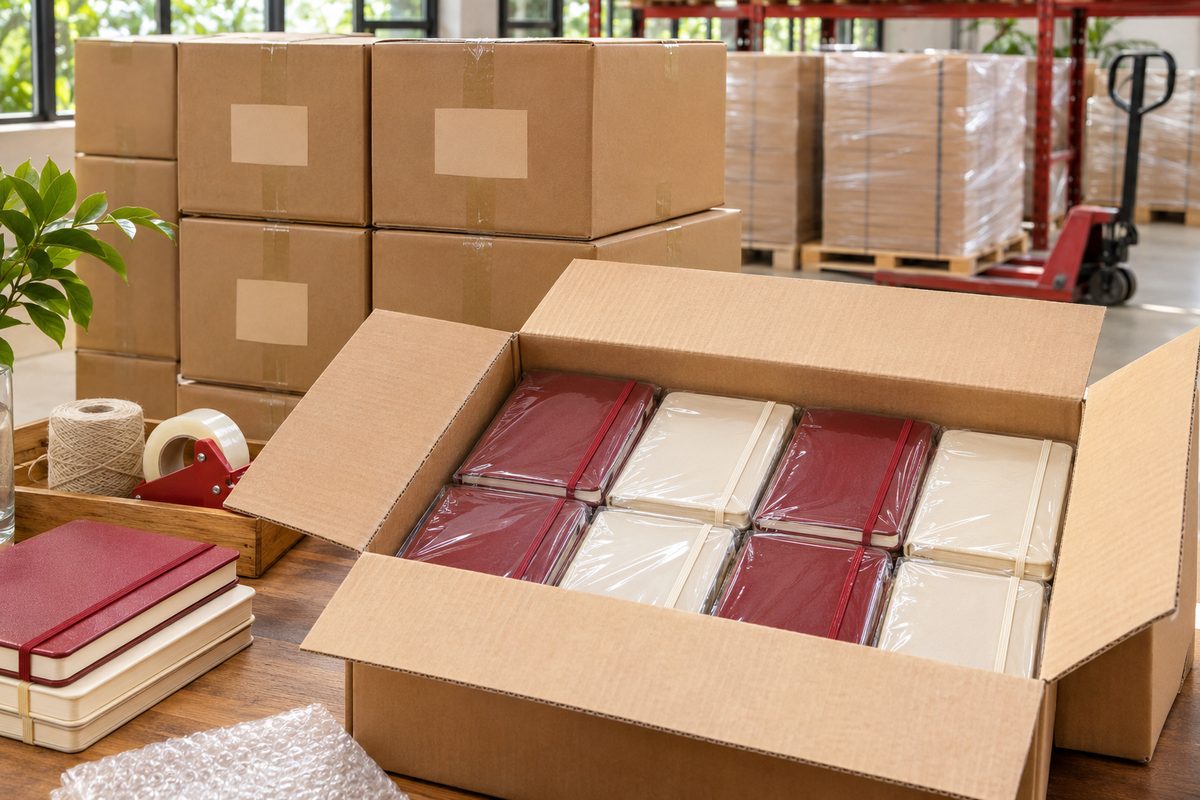
10. Shipping responsibilities are assigned. Ask how export cartons are packed and labeled, which shipping terms (Incoterms) apply, and who is responsible for freight, customs clearance, import duties and final delivery. U.S. buyers should also confirm who will act as the importer of record.
AI-generated illustration.
Quick checklist
Swipe sideways to see the full table.
| # | Ask the manufacturer | Good sign |
|---|---|---|
| 1 | Can you show notebooks like mine? | Photos or samples with the same construction |
| 2 | Which paper, which gsm? | Named paper and its trade-offs |
| 3 | What is the cover made of, and how is it finished? | Material and finish documented |
| 4 | What will my sample represent? | Real materials and written sign-off |
| 5 | What are your artwork requirements? | Published file guidelines |
| 6 | How do you match my colors? | Pantone or CMYK workflow |
| 7 | Can I verify your certifications and audits? | Records you can check yourself |
| 8 | How fast do you reply? | Specific answers in writing |
| 9 | When are deposit and balance due? | Stages tied to approvals |
| 10 | Who handles freight, customs and duties? | Shipping terms stated in writing |
Common mistakes
- Comparing quotes built on different specs.
- Approving a PDF proof and skipping the physical sample.
- Accepting certification claims without checking them.
- Leaving customs, duties and the importer of record undecided until the goods ship.
For the specification side of the project, see our Custom Notebook Buying Guide. Sampling and file preparation advice also appears in this planner-printing guide from Copper Bottom Design.
How PUNDY manages artwork and sample approval
PUNDY Co., Ltd. has made custom notebooks, journals and planners for brands since 1990. Our Ordering Process explains artwork submission, sample review and written approval before mass production. Buyers should check all content, spelling, layout and specifications before giving final approval.
PUNDY holds FSC® Chain of Custody certification (DNV-COC-002642 / FSC® C187900). Qualifying products can carry an applicable FSC claim when FSC-certified materials and documentation are specified at the quotation stage. PUNDY is a Sedex member and has completed a SMETA 2-Pillar audit.
FAQ
Should I get a physical sample before mass production?
Yes, especially for a new custom design. A physical sample lets you check paper feel, binding, construction and print appearance. Confirm which specifications the approved sample represents and how it will be used as the production reference.
How do I verify a notebook supplier's certification or audit?
Ask for the certificate, audit documentation or membership record. Check FSC chain of custody status in FSC's public records, and review the scope of any SMETA audit. Treat certifications, audits and memberships as separate things.
What files does a notebook manufacturer need?
Usually vector artwork for logos and line art, raster images with enough resolution at final print size (commonly 300 dpi), text converted to outlines, and bleed set to the supplier's specification. Check the supplier's published file requirements.
What if delivered notebooks don't match the approved sample?
Before you order, ask how the manufacturer inspects finished goods, how quality issues are documented and how nonconforming products are handled. Agree on acceptance standards and the claims process in writing.
Have a notebook project in mind?Send PUNDY your specification. We will review your requirements and respond as soon as possible.
Standard MOQ is 500 units per design.
Press Release
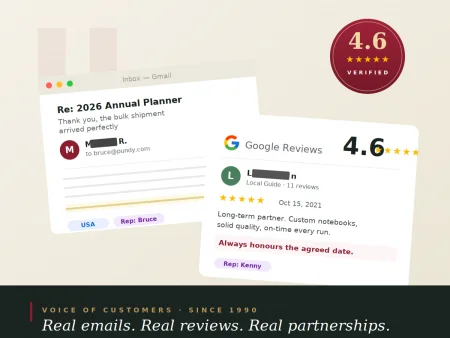 4.6★ on Google · Trusted Since 1990
Real emails from international clients. Real Google reviews from long-term partners. See what 36 years of getting the details right looks like — in their own words.
Read More Awards of Taiwan Golden Print
PUNDY won awards of Taiwan Golden Print in 2011.
Read More New Notebook for 2015
The business notebook designed by PUNDY is especially made for office users who love simple and fashionable designs.
Read More