
Coated vs Uncoated Paper: Gloss, Matte, Woodfree and Pantone C/U
Coated vs Uncoated Paper: Gloss, Matte, Woodfree and Pantone C/U
Coated vs uncoated paper explained: gloss and matte art paper, woodfree offset paper, one-color, Pantone spot, CMYK and Pantone C/U. AI scenes are illustrations; confirm color with printed samples.
PAPER & INK / A BUYER’S GUIDE
Coated vs Uncoated Paper:
same color,
different result?
First tell coated from uncoated paper.
Then compare one-color, Pantone spot and CMYK.
A color number is only half the brief: name the paper too.
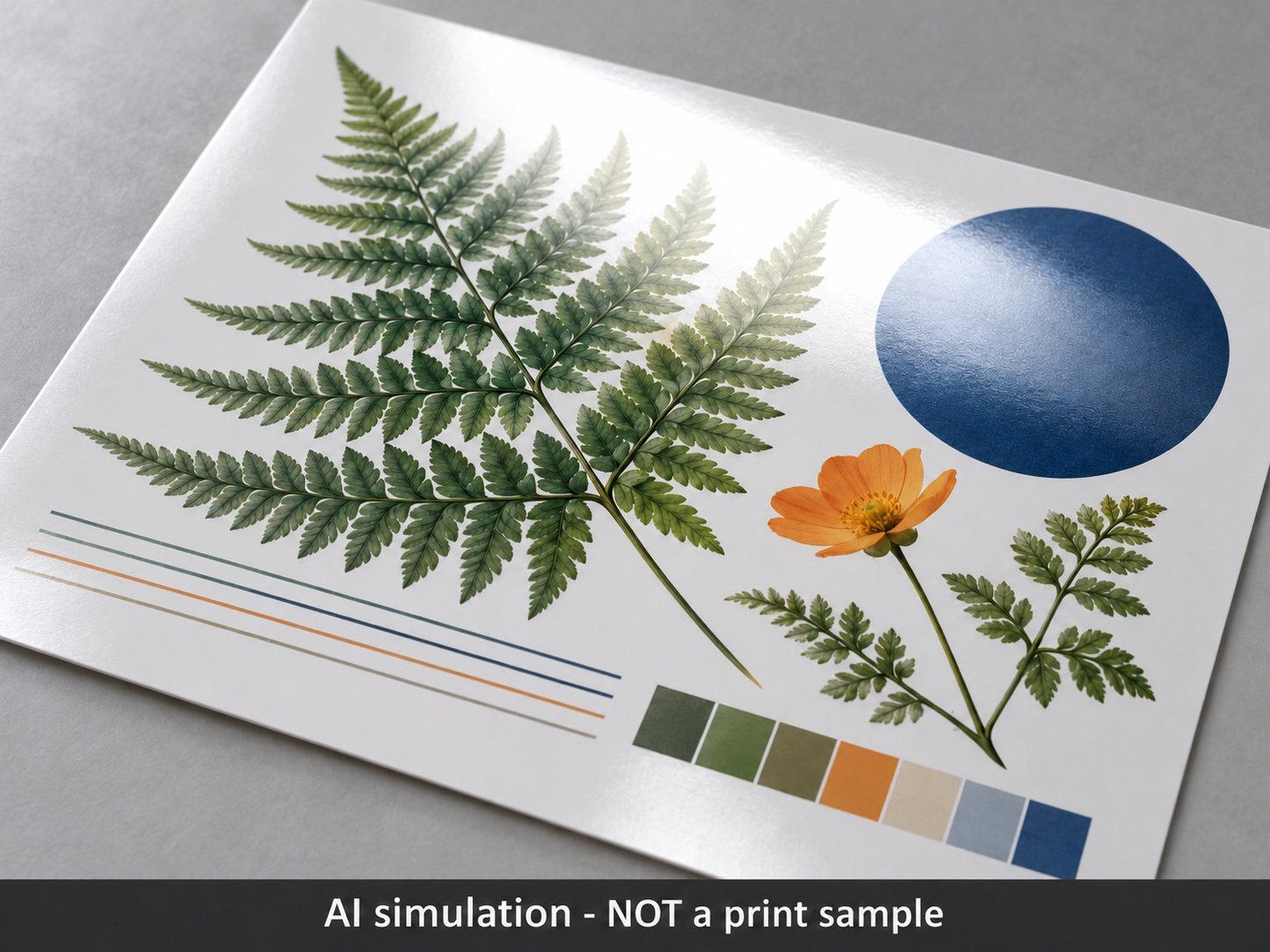
Coated vs uncoated paper: what is the difference?
Coated paper has a pigment coating on its printing surface. Uncoated paper has none, though it may still be sized or calendered. Gloss and matte art papers are usually coated; woodfree offset paper is a common uncoated paper. Confirm the class from the paper specification.
Surface treatment, absorbency and paper shade all affect how ink appears, so the same file or color number can look different on another paper. Confirm with printed samples on the specified paper, not on screen.
Paper and inks are
two separate decisions.
“One-color” is about how many inks are used; PMS is the Pantone Matching System; CMYK is four-color process. One Pantone spot color can also be a one-color job.
The six images were generated separately by AI. They are not a controlled comparison of the same artwork under the same light, and cannot be used to judge color differences, set K values or approve products.
The color patches are not swatches. Bright spots simulate reflections; they do not demonstrate how black ink will print.
Switches are not supported in this browser, so all scenes are shown.
Gloss coated × black only
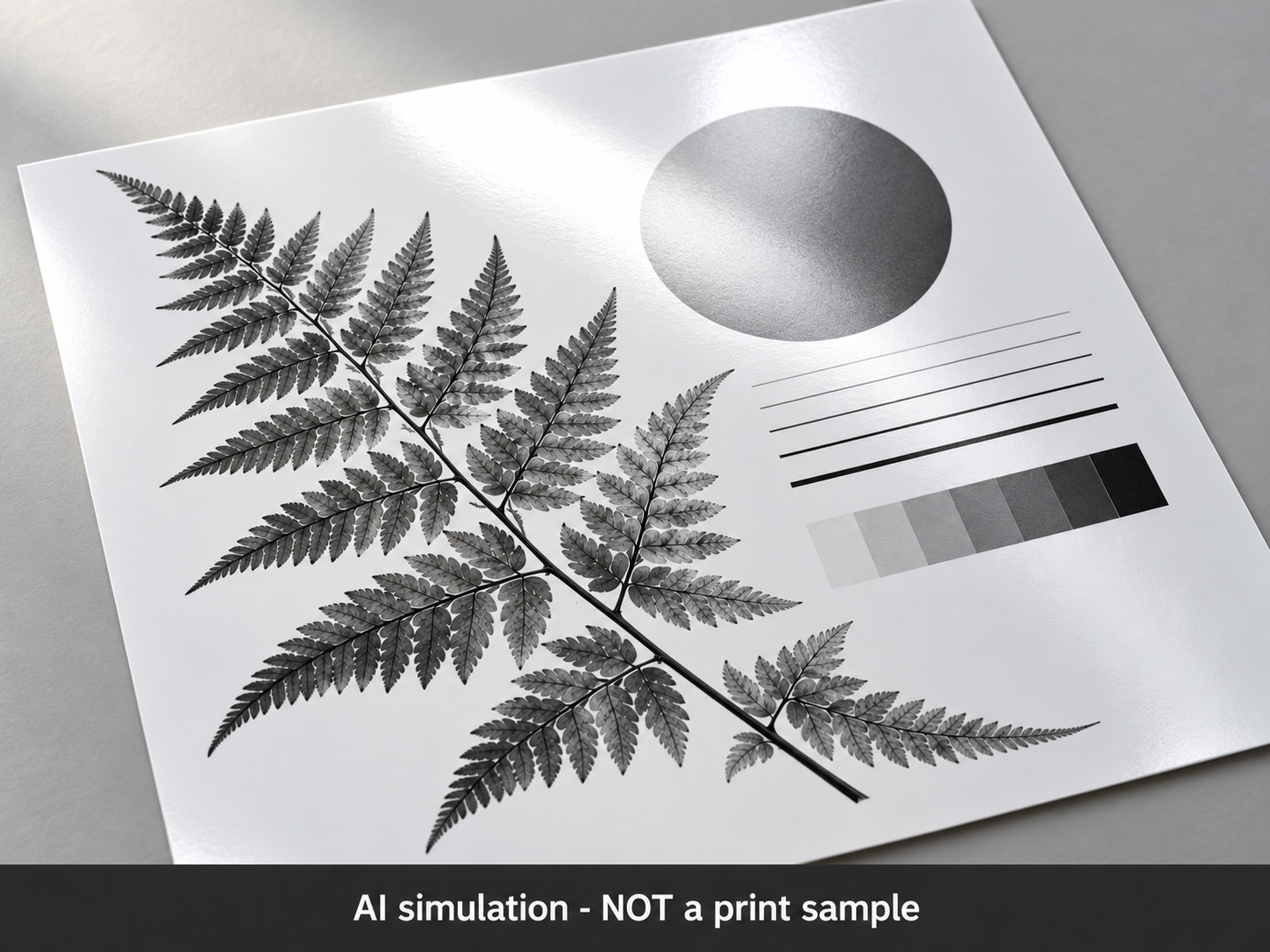
Not a color, K-value or paper reference.
Matte uncoated × black only
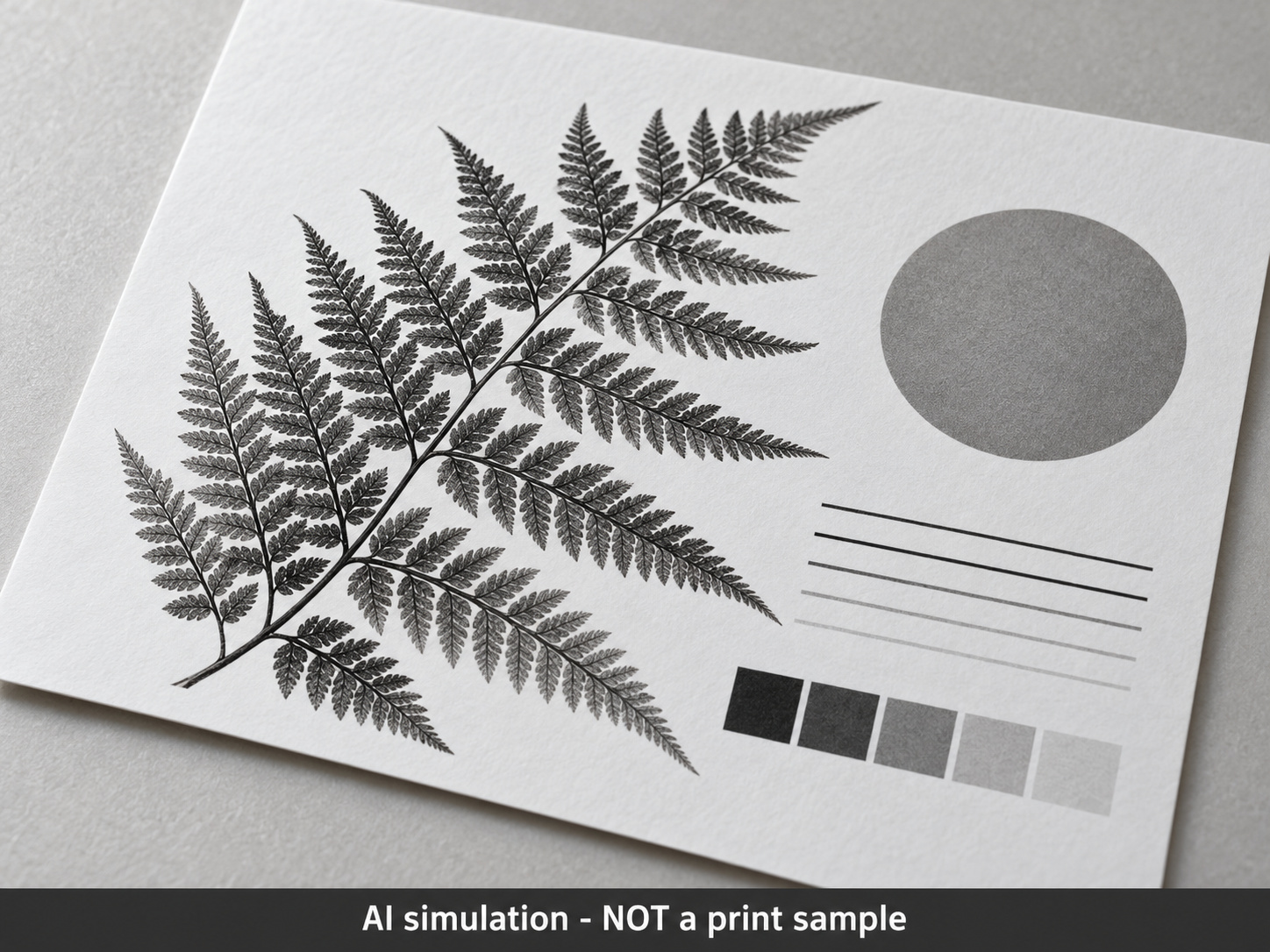
Not a color, K-value or paper reference.
Gloss coated × one spot color
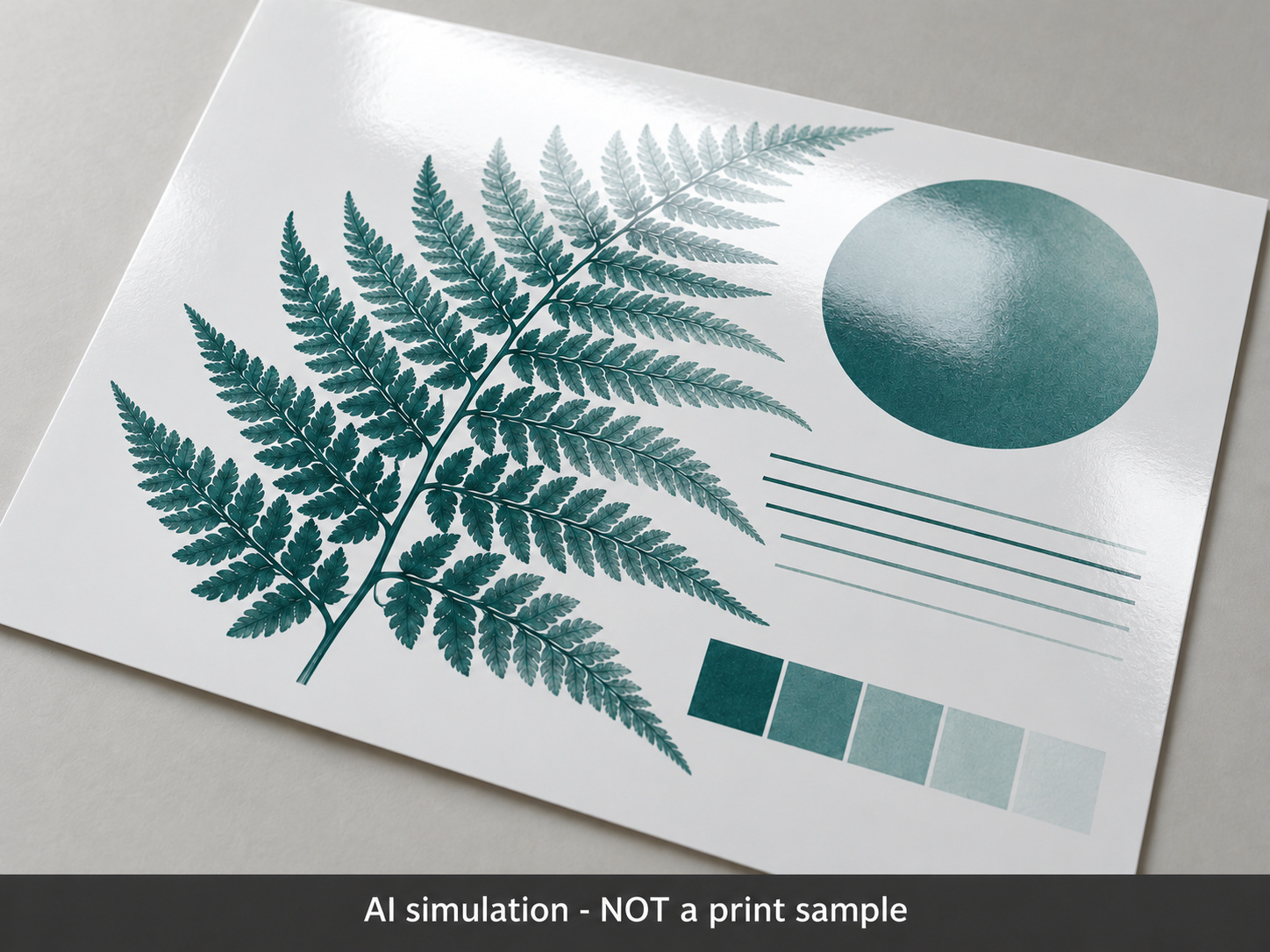
Not a color, K-value or paper reference.
Matte uncoated × one spot color
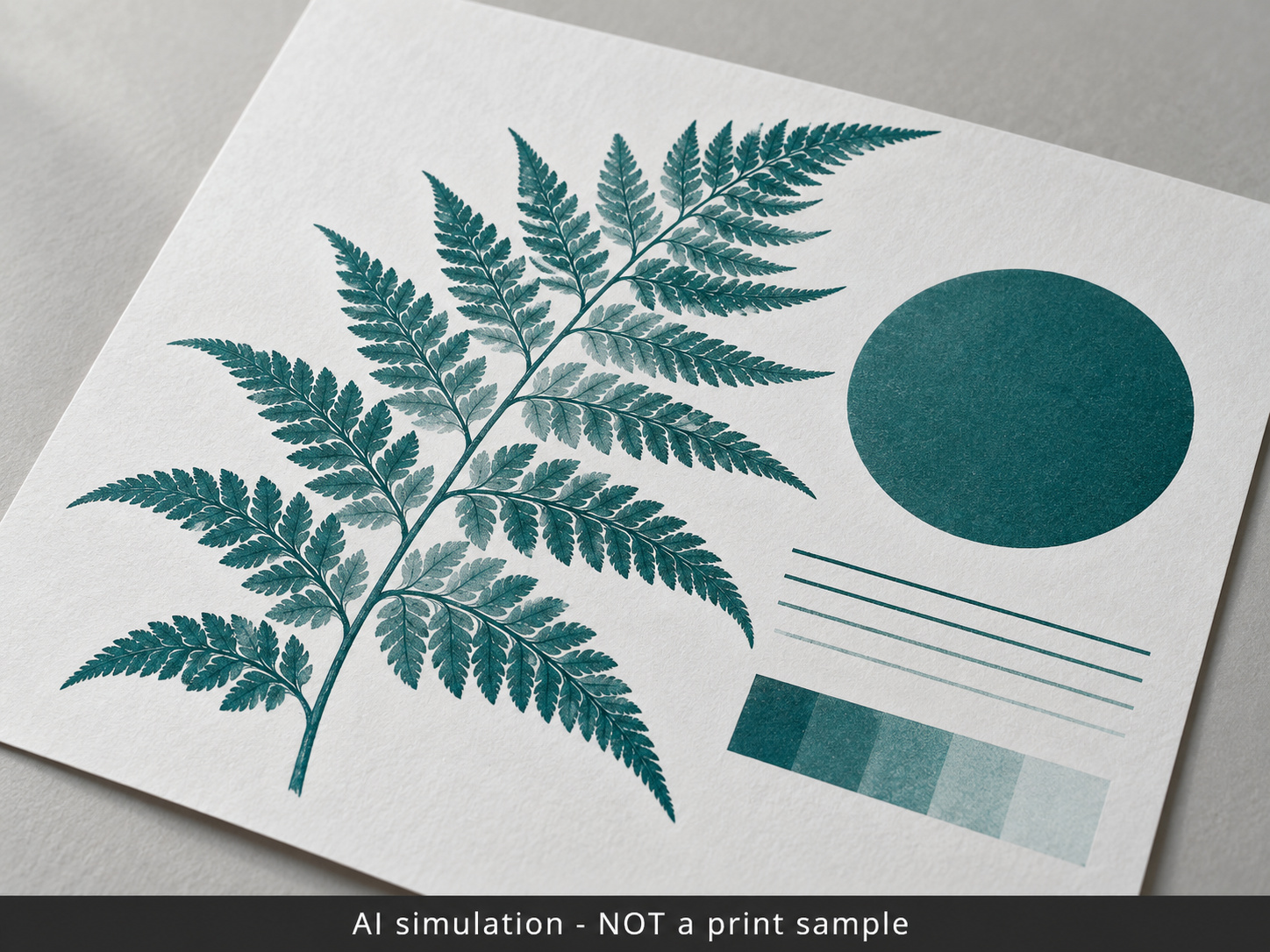
Not a color, K-value or paper reference.
Gloss coated × CMYK
Not a color, K-value or paper reference.
Matte uncoated × CMYK
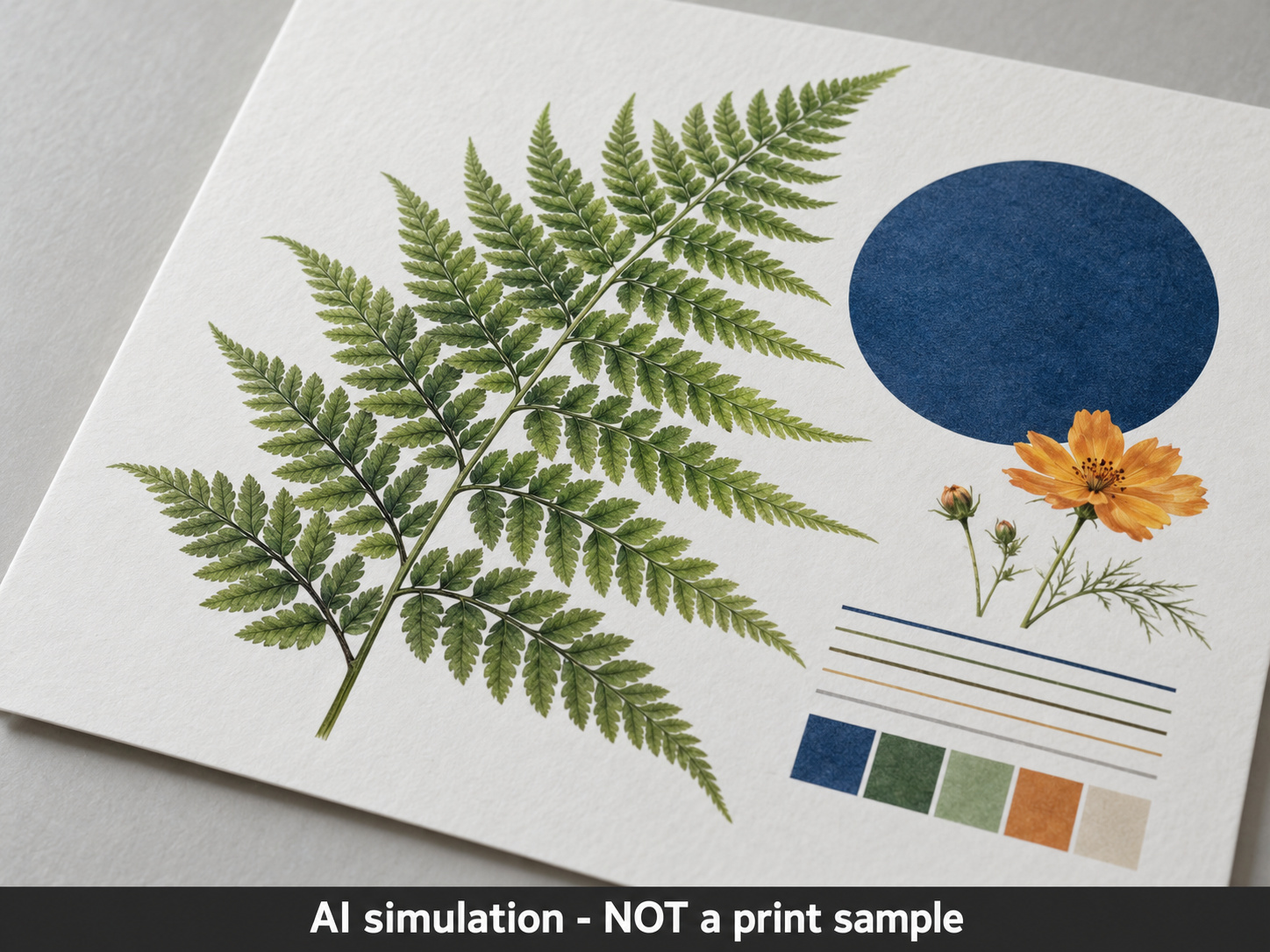
Not a color, K-value or paper reference.
We chose gloss coated and matte uncoated scenes to show reflection. Not all coated papers are glossy, and gloss alone does not identify a paper.
To compare real results, print the same file on the specified papers under the same conditions.
Coated, gloss example
A pigment coating changes the surface and how it prints. Coated papers can be gloss or matte.
Uncoated, matte example
No such coating, but it may still be sized or calendered. Uncoated does not mean rough.
One black ink can still print tints.
Text, lines and grayscale print from one black plate. Lighter screens use the same black ink, not an added gray.
One-color does not have to be black. It can be any single ink.
One premixed spot ink.
PMS (Pantone Matching System) provides color numbers and physical references. Here one ink is mixed to the specified color and printed from one plate, so it is also one-color.
Four inks, combined as dots.
Cyan, magenta, yellow and black halftone dots reproduce photos and multi-color art; four-color is not just four visible colors.
Both paper types can print CMYK; separation and proofing should suit the actual paper and press.
Squares only identify plates; they are not ink samples.
To confirm the look, check a printed sample on the specified paper.
Ink meets paper, color changes.
A coating affects how much ink stays on the surface; uncoated fibers absorb ink differently. Saturation, detail and dots can change, but not by a fixed rule such as “always X% lighter”.
Reference: Sappi on paper surfaces and ink holdout.
Paper shade is part of the picture.
On white and cream paper the unprinted areas already differ, and so may light tints. Compare whiteness, surface and separation together.
Gloss, matte, woodfree:
more than shine.
Look at the coating first, then gloss, inks and writing needs. Coated and uncoated are not “premium” and “standard” grades.
Coated: a printing coat on the surface
During papermaking, a coating with pigments such as kaolin clay or calcium carbonate is applied to make the printing surface more even and smooth. “Pigment” here is a papermaking coating, not printed color.
Coated paper can be finished gloss, silk or matte. Gloss and matte art papers are both coated, but their surface and print characteristics vary by grade.
Uncoated: no pigment coating
The surface shows more fiber, but it is not untreated: mills adjust absorbency and smoothness by sizing and calendering, so some uncoated papers feel very smooth.
Woodfree offset paper is common in books, letter paper and notebooks. Uncoated does not mean rough, prone to feathering or right for every pen; it depends on the paper.
Further reading: Valmet on calendering, smoothness and gloss; study on sizing and calendering of uncoated inkjet paper (specific inkjet tests, not PUNDY papers or production color).
Paper names you may hear from suppliers
Names are a starting point, not identical specs across mills or a PUNDY stock list. Taiwanese trade names are shown for reference.
Gloss art paper
A common coated paper for photos and full-color content. In Taiwan: 銅版紙; 亮銅 means gloss, and 特銅 is short for premium art paper.
“Art paper” alone is not enough: confirm gloss or matte, one- or two-side coating, and gsm.
Matte and silk art paper
Still coated, with less gloss. Compare samples if you want full color without mirror-like reflection. In Taiwan: 雪銅 or 雪面銅版.
Matte art paper is not gloss art paper with a matte laminate.
Woodfree offset paper, white or cream
Usually an uncoated printing and writing paper; white or cream is the paper shade, not the number of print colors. In Taiwan: 道林紙.
模造紙 is another Taiwanese name for printing and writing paper; do not treat it as a spec-identical substitute.
Lightly coated paper, PUNDY Kaan paper
Lightly coated paper is still coated. PUNDY Kaan lightly coated woodfree paper can be a starting point for everyday writing and printed content; writing pages need not be uncoated.
A trade name is not a coating spec: confirm the mill, full name and paper code, and test-write with your pens. About PUNDY Kaan paper ↗
Names: Dayeh paper categories (Chinese). For other trade names, rely on the supplier’s paper specification.
What changes when you change paper?
01 | Photos and solids
Coated surfaces usually favor detail and contrast; uncoated often looks softer. Whiteness, ink and press conditions matter too, so uncoated is not automatically dull.
02 | Fine lines and light grids
The same grid file can look different on another paper. Choose line weight, tone and size together; do not adjust K alone or judge tone from AI images.
03 | Writing and drying
Uncoated is common for writing, but sizing and surface affect feathering and drying, and coated paper is not automatically unwritable. Test your pens on a sample.
04 | Brand colors and PMS
The same spot ink or CMYK build can look different on another paper. Specify the paper and an acceptable printed sample; choosing C or U is not the last step.
Start with what you print,
then decide how many inks.
| Example | What to confirm | Typical uses |
|---|---|---|
| Black only one ink | Text, lines and grayscale share the black plate. Confirm light grids with line weight and paper, not K alone. | One-color pages, forms, notebook grids. |
| One spot color one ink | Give the full Pantone number with C or U, and confirm spot ink or CMYK simulation. Spot colors can also be screened. | Logos, a brand main color, large solid areas. |
| CMYK four inks | For photos and multi-color art. Some spot colors cannot be fully reproduced in CMYK; check after conversion. | Photos, illustration, color inserts. |
A job can also be CMYK plus a spot color; counting colors on screen does not tell you how many inks are used.
Keep the C or U
after a Pantone number.
It tells you what type of paper the reference color was printed on.
Read the suffix, not the screen
coated-paper reference
uncoated-paper reference
No Pantone swatches are shown here. A physical guide does not guarantee results on every paper.
Do the C and U versions look the same?
Not necessarily. Pantone’s C and U references show ink on different surfaces, so the same number is no guarantee.
Will changing C to U in my file fix the color?
Not by itself. Confirm the physical reference to match, the actual paper and whether a spot ink is used, and agree adjustments with the printer.
My logo has a Pantone number. Do I still need to discuss paper?
Yes. Paper shade, surface and finishing also affect the result. Share your brand guidelines and say what must match most closely.
Can’t uncoated paper print bright colors?
It can, but don’t expect it to match a coated paper. Compare samples suited to each paper; “softer” is not inevitable.
You don’t need every term.
Just tell us four things.
Which paper?
Full paper name, gsm, white or cream; a paper sample or label if you have one.
Which color reference?
Full Pantone number with C or U, brand guidelines or an existing printed piece. Photos are not a color standard.
What matters most?
Logo color, photo detail, or grid lines that stay behind the handwriting? Tell us your priorities.
How will we confirm?
Send original files and agree the printed sample and proofing with us before the spec is fixed.
Images are AI-generated and diagrams simplified; none is a PUNDY photo, Pantone swatch or print sample.
Press Release
 4.6★ on Google · Trusted Since 1990
Real emails from international clients. Real Google reviews from long-term partners. See what 36 years of getting the details right looks like — in their own words.
Read More Awards of Taiwan Golden Print
PUNDY won awards of Taiwan Golden Print in 2011.
Read More New Notebook for 2015
The business notebook designed by PUNDY is especially made for office users who love simple and fashionable designs.
Read More