
Overseas Notebook Manufacturer vs. Local Printer vs. Print-on-Demand
Overseas Notebook Manufacturer vs. Local Printer vs. Print-on-Demand: How to Choose for Your Planner Brand
Print-on-demand, a local printer or an overseas notebook manufacturer? Compare paper, binding, covers, samples, logistics and inventory for your planner brand.
Overseas Notebook Manufacturer vs. Local Printer vs. Print-on-Demand: How to Choose for Your Planner Brand
Short answer: Use print-on-demand (POD) to test a design with no inventory, a local printer when proximity and in-person proof reviews matter, and an overseas notebook manufacturer when the product itself is the brand: a specific paper, a sewn or hardcover binding, a custom cover material, or a mix of materials and finishing that one supplier needs to coordinate. Many planner brands use more than one route over time.
What each route is good at
Print-on-demand prints each order as it comes in. Lulu, for example, supports single-copy printing, and its notebook page highlights three popular formats (A5 paperback, US Letter paperback and US Trade coil bound), each shown with a standard black-and-white interior on 60# paper (Lulu notebooks). That makes POD useful for testing a layout without holding inventory. Available specifications vary by provider and product, so check specialty paper, cover and finishing options with each provider.
A local printer (a commercial printer in your own country) can be a strong option when proximity, easy communication and proof reviews matter. Some also offer notebook-specific work such as sewn binding, rounded corners, elastic closures, pockets or ribbon markers, either in-house or through production partners. Ask what they actually do, how they control quality, and who is responsible for any outsourced step.
An overseas notebook manufacturer specializes in notebooks: it sources the paper, coordinates printing, and binds and finishes the book. Ask which steps happen in its own factory and which go to partners. This is where specialty paper (for example Tomoe River S), PU cover material (a polyurethane synthetic, commonly called PU leather — not genuine leather) or genuine leather covers, foil stamping and debossing, and custom packaging become practical. The trade-offs are a minimum order quantity, a physical sample round, and international freight and customs to plan for.
Side-by-side comparison
Typical sourcing models compared below; actual specifications and services depend on each supplier.
Scroll the table sideways to see all columns.
| Print-on-demand | Local printer | Overseas notebook manufacturer | |
|---|---|---|---|
| Best for | Testing designs, one-off orders | Short runs, close communication | Branded products at scale, specialty specs |
| Paper choice | Platform and product options | Printer's stock list | Wide; specialty papers on request |
| Binding | Platform's options (e.g. paperback, coil) | Varies; ask what is done in-house | Wide: e.g. sewn, perfect, saddle-stitch, loose-leaf, spiral, hardcover |
| Cover options | Platform's cover and finish options | Varies | PU, genuine leather, cloth, foil, deboss |
| Physical sample | Order a copy | Often a press proof | Pre-production sample of your design |
| Logistics | Ships to each customer | Local delivery | Freight, customs and duties to plan |
| Inventory | Usually no finished stock when printed to order | Depends on ordering, storage and fulfilment | Depends on ordering, storage and fulfilment |
Four questions that decide it
- Is the paper part of your promise? If customers buy because of fountain-pen performance or low show-through, compare physical samples for feathering, bleed-through, show-through and drying time rather than relying on paper weight alone. You need a supplier who can name the paper and its weight and send you a sample.
- How will you sell? Selling one unit at a time with no warehouse suits POD. Wholesale, Kickstarter fulfilment or a retail launch usually needs a production run.
- How many units can you commit to per design? Ask each supplier for its minimum order quantity in writing before you design around it.
- Who will check the files and colors? File checks, manual review and proofing differ between suppliers. Before you send files, confirm the file requirements and who signs off the proof.
Also compare these
- Quality control and defect responsibility. Who inspects the order, and how are color variation, binding defects and quality disputes handled?
- Reorders and consistency. Brand products get reordered. Ask whether the same paper, colors and finishing can be matched on the next run.
- Total cost, not unit price. Include sampling, setup, freight, duties and storage.
- Paper weight units. US "60#" and metric gsm are different measuring systems, so the numbers cannot be compared directly.
Common mistakes
- Comparing quotes built on different specs. A quote for 80gsm woodfree paper and perfect binding is not comparable with one for 68gsm Tomoe River S paper and sewn binding. Send every supplier the same specification sheet.
- Skipping the physical sample. A PDF proof cannot show paper feel, show-through or how flat the book opens.
- Sending screen files. Follow each supplier's file requirements for color mode, bleed, image resolution, and font embedding or outlining (Copper Bottom Design on finding a printer and sampling; PUNDY print-ready file guidelines).
- Forgetting the landed cost. For overseas orders, agree in writing who pays freight, insurance, customs clearance and import duties. Incoterms rules define the delivery, cost and risk split between buyer and seller (ICC Incoterms® rules); confirm inspection, acceptance and defect handling separately in your purchase order or contract.
Checklist before you choose
- I know which specs are non-negotiable (paper, binding, cover, size, page count).
- I have a one-page specification sheet to send every supplier.
- I have each supplier's MOQ and payment terms in writing.
- I have held a physical sample of my own design, or a close equivalent.
- I know who handles files, proofs and color matching, and who is responsible for defects.
- For overseas production, I know the shipping terms and my landed cost.
FAQ
Can I start with print-on-demand and move to a manufacturer later?
Yes. A common path is to validate a layout on POD, then move to a production run when you need a specific paper, binding or cover. Expect to adjust files to the new supplier's specifications.
Is an overseas manufacturer only for large brands?
Not necessarily, but production runs have minimums. Ask early and plan your first design around it.
How do I compare an overseas manufacturer with a local printer?
Use the same specification sheet, then compare the sample, the written terms, quality responsibility and the landed cost, not only the unit price. Our 10-point manufacturer checklist lists the questions to ask.
Working with PUNDY
PUNDY has made custom notebooks, planners and journals in Taiwan since 1990. Printing is handled by our partner printing plants; the main post-press processes and quality inspection are done in our own factory (how a notebook is made). We approve a physical sample with you before production. If your planner needs a specific paper, such as Tomoe River S, or sewn-and-glued binding, exposed-spine sewing or a hardcover, send us your specification sheet. We will review your requirements and respond as soon as possible. Standard MOQ is 500 units per design.
Press Release
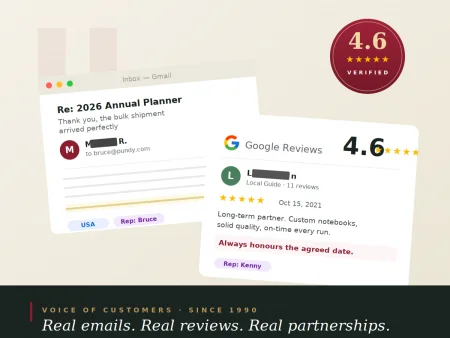 4.6★ on Google · Trusted Since 1990
Real emails from international clients. Real Google reviews from long-term partners. See what 36 years of getting the details right looks like — in their own words.
Read More Awards of Taiwan Golden Print
PUNDY won awards of Taiwan Golden Print in 2011.
Read More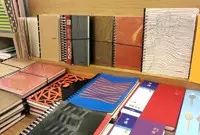 New Notebook for 2015
The business notebook designed by PUNDY is especially made for office users who love simple and fashionable designs.
Read More